

 Azərbaycanca
  По-русски
  English
 About us
Media: Ukraine has created a cheap analogue of Patriot missiles
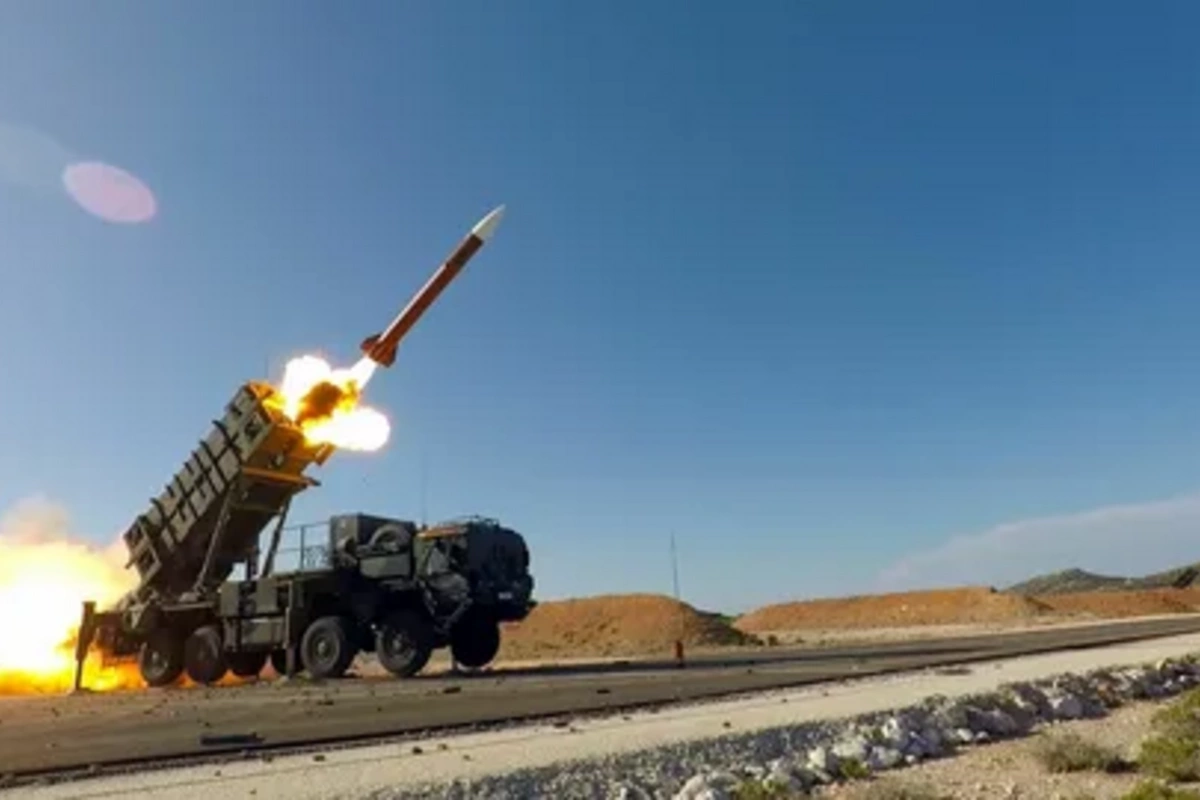
Ukraine has tested a new surface-to-air missile developed as a cheaper and mass-producible alternative to the scarce American Patriot system. Kyiv is struggling to obtain enough Western interceptor missiles to protect its cities from constant Russian missile strikes and drone attacks, such as last week's massive assault that killed at least 22 people across Ukraine.
This is reported by the Financial Times (FT).
Ukrainian weapons manufacturer Fire Point said it conducted the first flight test of its FP-7.x anti-missile interceptor last week, which co-founder Denys Shtylierman described in an interview with the FT as "quite successful."
Fire Point emphasized that the FP-7.x is designed to counter Russian ballistic missiles and drone threats at a fraction of the cost of existing Western systems such as Lockheed Martin's Patriot and the Franco-Italian SAMP-T, and could eventually be produced in much larger quantities.
Mass production of the missile could begin in August, Shtylierman explained, pending delivery of an infrared seeker head that Fire Point hopes to obtain from the German company Diehl Defence. The missiles will be fully ready by 2027, he said.
Who Fire Point is partnering with
The rest of the air defense system — known as Freyja — including radars used for detection and targeting of aircraft, as well as the command and control system, will come from European partners.
Fire Point declined to confirm or deny exactly who they are working with, but European and Ukrainian officials say Fire Point has been in talks with Germany's Hensoldt and Thales regarding radars, Italy's Leonardo regarding tracking and fire-control radars, and Norway's Kongsberg regarding command and control technologies.
"The completion of this depends on the speed of our Western partners and when they start moving," he emphasized.
The Patriot system problem
American defense conglomerate Lockheed Martin produces hundreds of interceptors per year for the Patriot system, but much of the output has gone toward replenishing stocks expended in the war with Iran.
Ukrainian experts say the nightly thunder of Russian air attacks, along with the slow replacement of PAC-2 and PAC-3 missiles, has undermined confidence in the Patriot system.
"Can we count on Patriot? I don't think so anymore," said Dmytro Kuleba, former Foreign Minister of Ukraine. "America's overall industrial capacity, given recent events in Iran, demonstrates that it will keep the best for itself."
Ukrainian President Volodymyr Zelensky also complained about reduced Patriot deliveries "because of the war in the Middle East," emphasizing: "Everything we could, we replaced with our own domestic production, but we still cannot replace the PAC-3. We are already working with several countries on developing European anti-ballistic capability," Zelensky said, apparently referring to the Freyja system.
Ukraine can afford rapid production rates
Shtylierman explained that his interceptor costs $700,000, compared to $3.8 million per missile for the Patriot PAC-3, according to 2026 budget estimates published by the U.S. Army. Fire Point can produce three per day starting in August, and they can be stored until the seeker head is attached, he added.
The rapid production rates in Ukraine compared to Western countries have been largely made possible by a wartime economy that accelerates military production.
"Today we probably have the least bureaucratic approach to producing anything in the aerospace field," Shtylierman said.
The most difficult part of developing anti-ballistic missiles, according to defense consultant Mark Lange, is that they are hard to test. "Only extensive operational use and engineering work can help lift this curse," he emphasized.
On the other hand, Ukraine has the gift and curse of constant Russian ballistic missile strikes, and this is one factor that could help shorten timelines, the article states.
FP-7.x may surprise
Fire Point faced skepticism last year when it announced it would build cheap cruise missiles. But it has recently achieved successes with its long-range FP-1 drone, which struck Russian oil refineries and a warship in the St. Petersburg area.
The medium-range FP-2 variant is also actively used by Ukrainian forces to strike Russian logistics routes in Moscow-controlled Ukrainian regions.
Experts say the missiles, which are not particularly stealthy, are able to exploit the advantage of sparse radar coverage in Russia due to the country's size. "Fire Point has already proven more than once that they can pull a rabbit out of a hat," Lange emphasized.
Shtylierman said the FP-7.x has a flight ceiling of 25 km, the same as Patriot, and like the PAC-3, it is designed to be fast enough to intercept ballistic missiles.
Unlike the Patriot, which is guided by an advanced ground-based fire-control radar, the FP-7.x is radar-guided but uses a thermal seeker on the "last mile," according to a Fire Point representative. Heat-seeking guidance is generally considered less effective than radar guidance due to the presence of decoys and countermeasures.
Tom Karako, a missile defense expert at the Center for Strategic and International Studies in Washington, said the FP-7.x could augment Ukraine's air defense arsenal, which includes older Soviet systems, American Hawk missiles, and modern German IRIS-T interceptors. But he added that the Freyja system is unlikely to become a full replacement for more advanced systems such as Patriot.
"When you face the full spectrum of threats, you need many different tools," Karako said. "Patriot is very sophisticated technology, so perhaps 'complement' would be a better word than 'replacement.'"

Similar News
IRGC: Iran Destroyed Hangars with F-35 Fighter Jets at U.S. Air Bases
In response to US strikes, Iran's air force struck American military bases in the Middle East and destroyed hangars housing F-35 fighter jets. This was reported...