

 Azərbaycanca
  По-русски
  English
 About us
AI shocked scientists by solving an 80-year-old mathematical problem
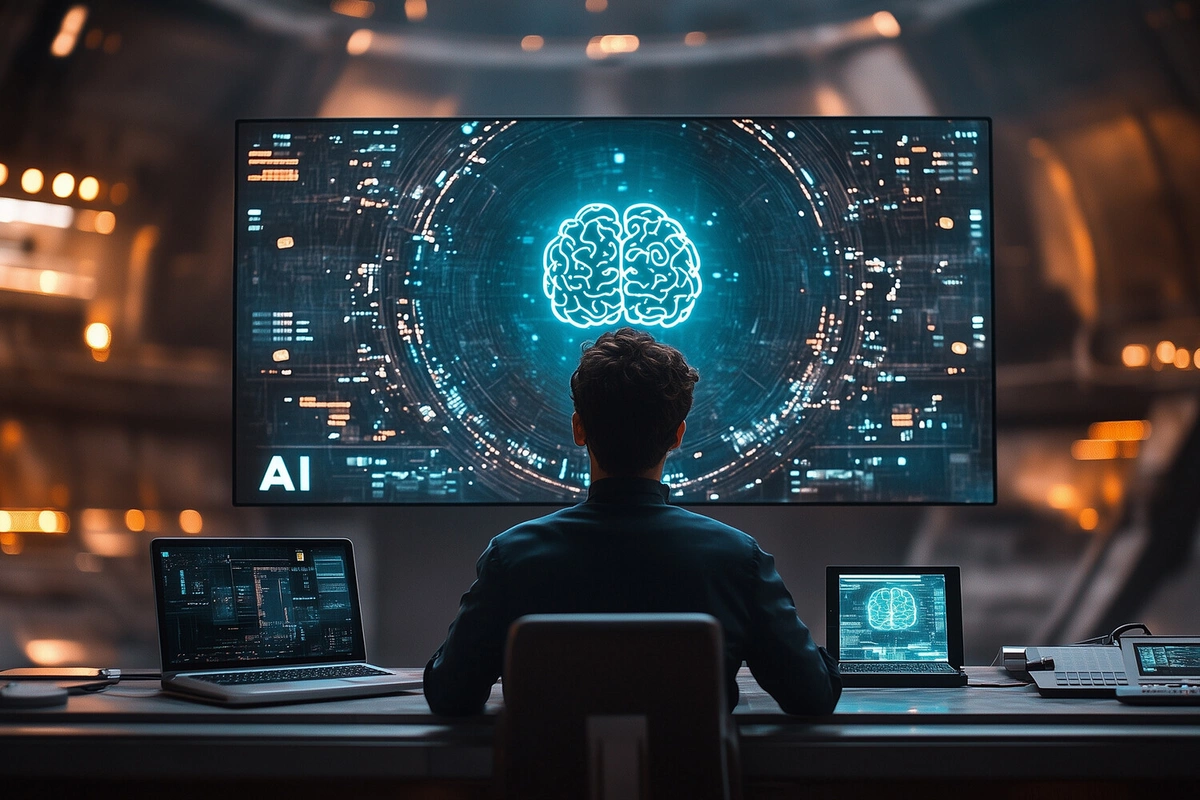
OpenAI has announced that one of its internal AI models found a counterexample to a well-known mathematical conjecture by Hungarian mathematician Paul Erdős, formulated back in 1946. The result is already being called one of the first truly significant mathematical discoveries made by artificial intelligence. This was reported by The Conversation.
The problem in question is the so-called planar unit distance problem, also known as Erdős Problem #90. The problem is stated simply: if a certain number of points are placed on a plane, how many pairs of points can be positioned exactly one unit distance apart from each other?
For decades, mathematicians believed that the best solution was provided by structures resembling a square grid. Erdős himself assumed that it was impossible to substantially improve upon such a configuration, even with a very large number of points. However, OpenAI's AI demonstrated that more efficient constructions exist.
To prove this, the model used methods from algebraic number theory and constructed point arrangements that yield more pairs at unit distance than the classical square lattice.
Canadian mathematician Daniel Litt called the result "the first autonomously obtained AI mathematical result that is genuinely interesting in its own right." Researchers were particularly struck by the fact that the problem was solved not by a specialized mathematical system, but by a general-purpose language model.
After the work was published, American mathematician Will Sawin was already able to improve upon the result using a similar approach. At the same time, researchers from Google DeepMind reported solving nine other open Erdős problems using their own AI models.
Fields Medal laureate Timothy Gowers stated that if a human had submitted a similar paper, he would "without hesitation" recommend it for publication in the Annals of Mathematics — one of the most prestigious mathematical journals in the world.
At the same time, scientists emphasize that AI is not necessarily yet capable of true "breakthroughs" that are traditionally considered the most inherently human aspect of mathematics. In the experts' opinion, the model was rather able to effectively combine already existing ideas and test an enormous number of variants without time constraints.


Similar News
The forgotten particle explained to astrophysicists why the Universe exists
Matter defeated antimatter thanks to a heavy neutrino that physicists had considered an inconsequential detail for decades. Due to its slow decay, the particle...