

 Azərbaycanca
  По-русски
  English
 About us
The true reason for the rapid fading of stars in the Universe has been discovered
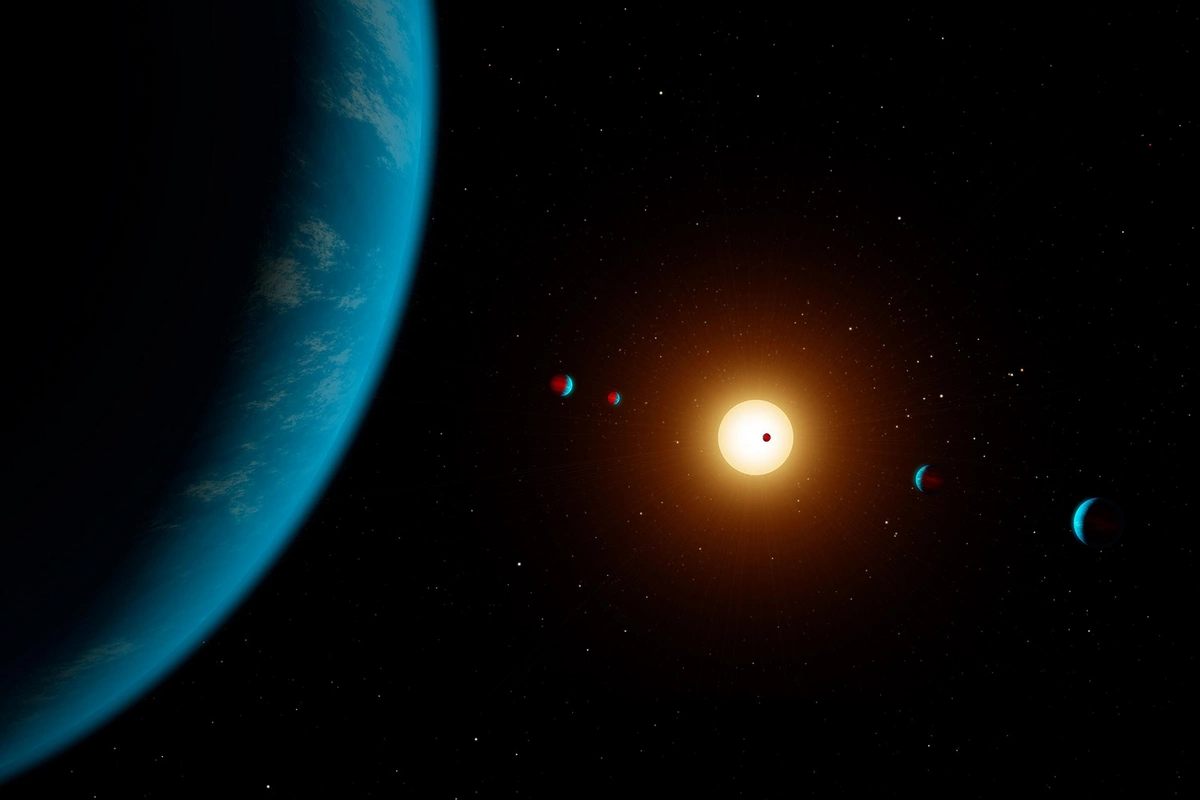
An international team of astronomers led by specialists from the Chinese Academy of Sciences has discovered the true reason behind the sharp decline in star formation in the Universe. It turns out that the main problem lies not in a deficit of hydrogen fuel, as was previously believed, but in a decrease in the efficiency of its conversion. The results of the study have been published in the journal Nature Astronomy.
Over the past 4.5 billion years, the rate of new star formation has dropped by more than half. Researchers had generally assumed that the Universe was simply running out of "fuel," but data from the FAST radio telescope and the DESI dark energy survey instrument showed that reserves of neutral atomic hydrogen — the primary gas for galaxy formation — have decreased only slightly. Scientists analyzed data on 2.5 million galaxies covering nearly a third of the celestial sphere and found that 4.5 billion years ago, the intensity of star formation was 2.5 times higher than it is today, while the hydrogen density exceeded current levels by only 1.4 times.
For a long time, astronomers were unable to accurately measure the evolution of cosmic hydrogen because the radio signal from individual distant galaxies was too weak and was lost in background noise. To overcome this obstacle, researchers from the National Astronomical Observatories of China applied a spectral stacking method: the mathematical combination of hundreds of thousands of weak radio signals to extract an average hydrogen measurement.
According to the scientists, this breakthrough shifts the focus of scientific inquiry from the question of gas reservoir depletion to the problem of declining matter conversion efficiency. Stars are born in dense molecular clouds, and neutral atomic hydrogen serves as a crucial intermediate stage between the global cosmic gas supply and the formation of new stars.
The study shows that as the inflow of gas from the cosmic web weakens, the efficiency of converting atomic hydrogen into molecular hydrogen also decreases. This mechanism allows the overall gas reservoir to remain relatively stable, while the fuel that directly feeds star formation gradually dwindles.


Similar News

A non-obvious danger of frequent swimming in pools has identified
Regular visits to a swimming pool can lead to infection with molluscum contagiosum - a viral skin infection that is transmitted through contact with an infected...