


 Azərbaycanca
  По-русски
  English
 About us
The decade-long mystery of the "pink planet" has been revealed
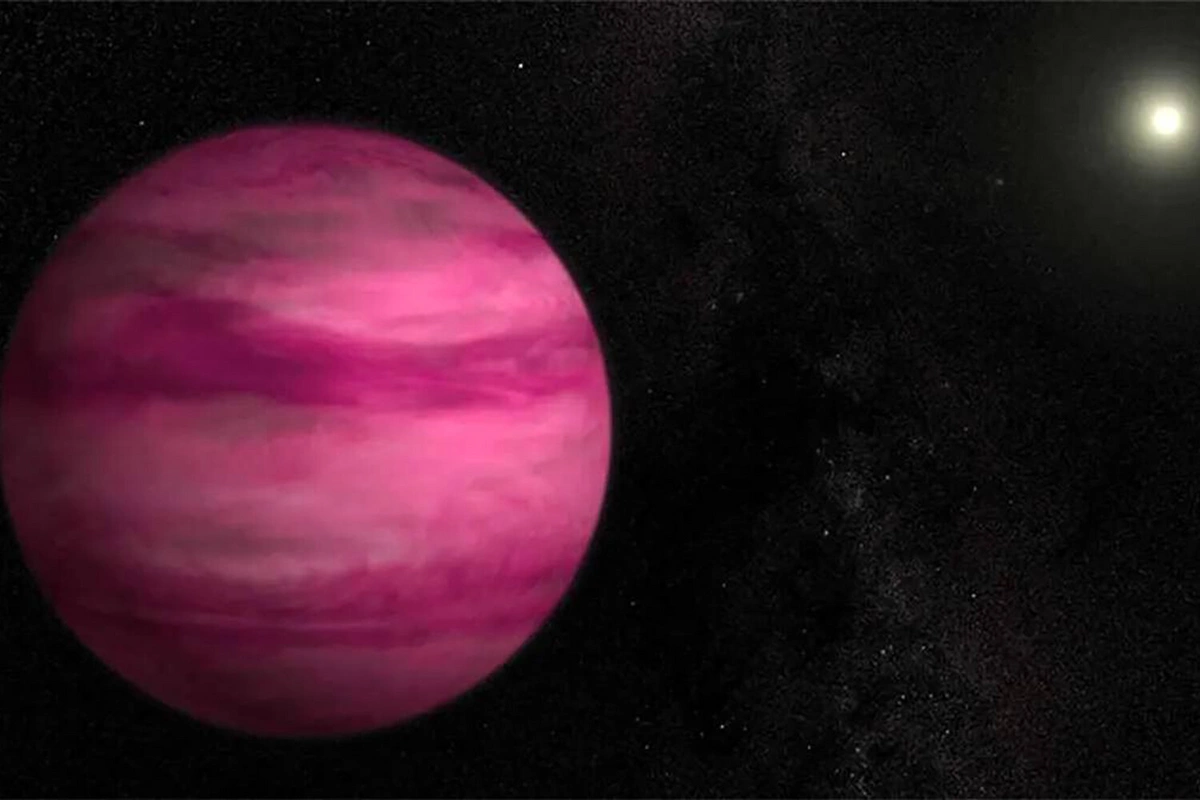
Astronomers at Northwestern University have solved the mystery of the "pink planet" — a cold object 57 light-years from Earth that had puzzled scientists for over a decade. The James Webb Space Telescope detected something in its atmosphere that had never been directly observed before: clouds made of salt. The study was published in The Astronomical Journal (AstroJournal).
The object, known as GJ 504 b, was discovered in 2013. With a mass roughly 25 times that of Jupiter, it straddles the boundary between a giant planet and a brown dwarf, and its temperature is only about 290 °C — comparable to the temperature inside an oven while baking bread. It is precisely this coolness that made the object inaccessible to ground-based telescopes: its light is too faint against the background of its host star.
"In the past, other teams observed it for an entire night with the largest ground-based instruments and saw nothing. JWST did it in about two hours," said Anish Baburaj, a postdoctoral researcher at Northwestern University's CIERA Center.
The spectrum obtained by the telescope revealed water vapor, methane, carbon dioxide, and ammonia in the atmosphere. Computer modeling initially produced physically unrealistic results — until the researchers added clouds to their models. The data were best described by clouds of sodium chloride and sodium sulfide: they obscure the deeper layers of the atmosphere and alter the spectrum reaching the telescope.
"We tested three types of clouds, and the salty ones fit the best," Baburaj added.
The discovery does not end there: the analysis also points to an unusually high content of heavy elements in the atmosphere — a clue about how the object formed. It may have formed as a planet, or possibly as a small star. Additionally, the age of GJ 504 b is estimated at 2.5–4 billion years, which explains its relative coolness: giant planets gradually cool down as they age.
According to the researchers, the methods developed for this observation will pave the way for studying other cold and dim objects previously unreachable from Earth.

Similar News

A tea that helps lose weight has been named
Ginger tea enhances thermogenesis, meaning it helps the body expend more energy even at rest, which promotes weight loss, gastroenterologist Evgeny Belousov fro...