

 Azərbaycanca
  По-русски
  English
 About us
Scientists Capture Supernova Explosion from the Early Universe for the First Time
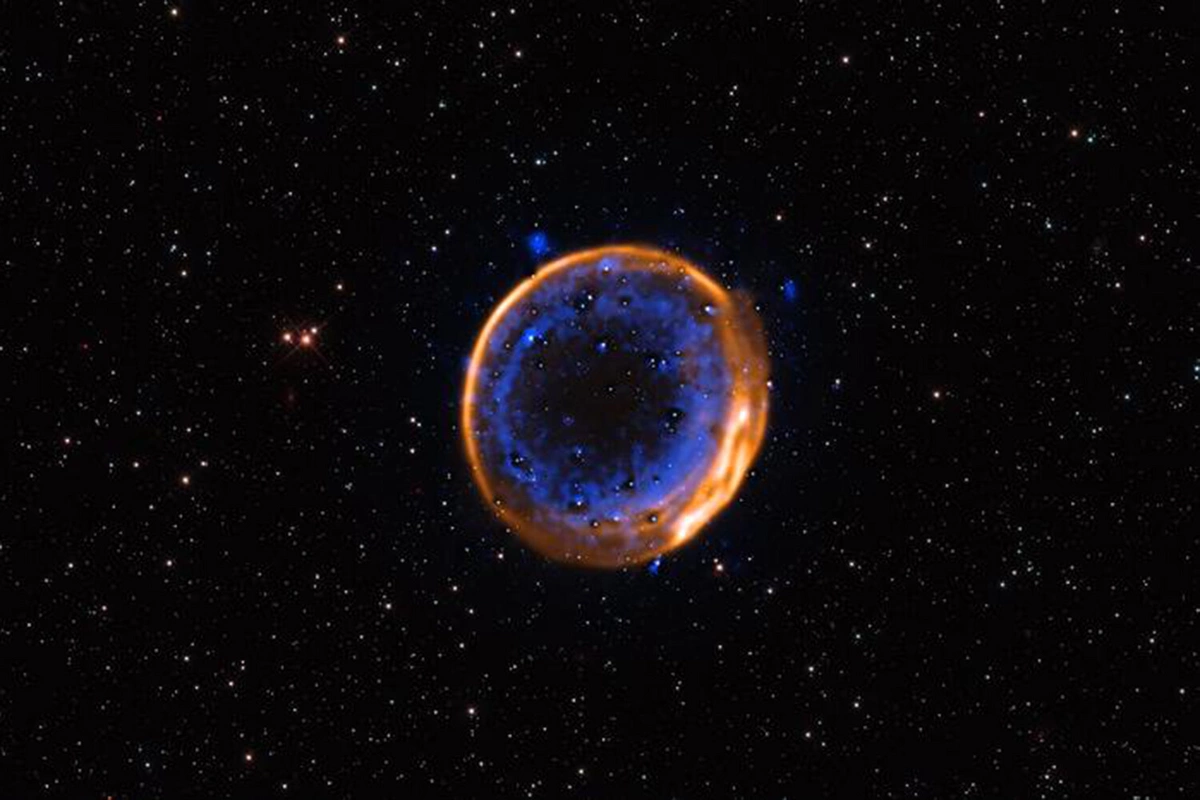
An international team of astronomers using the James Webb Space Telescope has directly captured a supernova explosion at a record-breaking cosmological distance for the first time. The event occurred when the Universe was only about 730 million years old - during the epoch of reionization, when the first stars and galaxies were just beginning to form.
The work is published in the journal Astronomy & Astrophysics (A&A).
The supernova is associated with the gamma-ray burst GRB 250314A. The gamma-ray burst itself was registered on March 14, 2025, by the SVOM space observatory, and its extreme distance was confirmed by subsequent observations using the Very Large Telescope of the European Southern Observatory. Data obtained approximately 110 days after the burst using the NIRCam infrared camera aboard the James Webb telescope played a crucial role, allowing scientists to separate the light of the explosion from the weak emission of the host galaxy.
"The main evidence linking gamma-ray bursts to the death of massive stars was finding a supernova at the same point in the sky," noted co-author of the study, astrophysicist Antonio Martin-Carrillo. "Almost all supernovae that we studied before were relatively close. When we realized how ancient this event was, it became clear that we had a unique opportunity to look at the conditions of the early Universe and understand what kinds of stars were being born and dying then."
According to the scientist, researchers used models of supernovae associated with gamma-ray bursts in the local Universe to predict the expected radiation.
"To our surprise, the model worked very well: the observed supernova turned out to be surprisingly similar in its properties to the explosions of massive stars that we see around us today. We also managed to see for the first time the galaxy in which this dying star was located," added Martin-Carrillo.
Analysis showed that the distant supernova is comparable in brightness and spectral characteristics to the prototype of such events - SN 1998bw, observed in the nearby Universe. This means that the massive star that produced GRB 250314A was not much different from its modern counterparts, despite fundamentally different conditions of the early cosmic environment, including extremely low metallicity. The data also rules out a scenario of a more exotic and bright explosion.
The results call into question the idea that the first stars should have died fundamentally differently than modern ones, and provide an important reference point for theories of stellar evolution in the early Universe. In the next one to two years, the team plans to conduct follow-up observations. By that time, the light from the supernova should have significantly weakened, which will allow detailed study of the properties of its host galaxy and definitively confirm the contribution of the explosion itself to the observed radiation.

Similar News
China was the first in the world to send artificial embryos into space
Chinese scientists have sent artificial embryos to the Tiangong Space Station to find out whether humans could reproduce in zero gravity conditions in the futur...