

 Azərbaycanca
  По-русски
  English
 About us
Monkeys found to possess a trait previously considered unique to humans
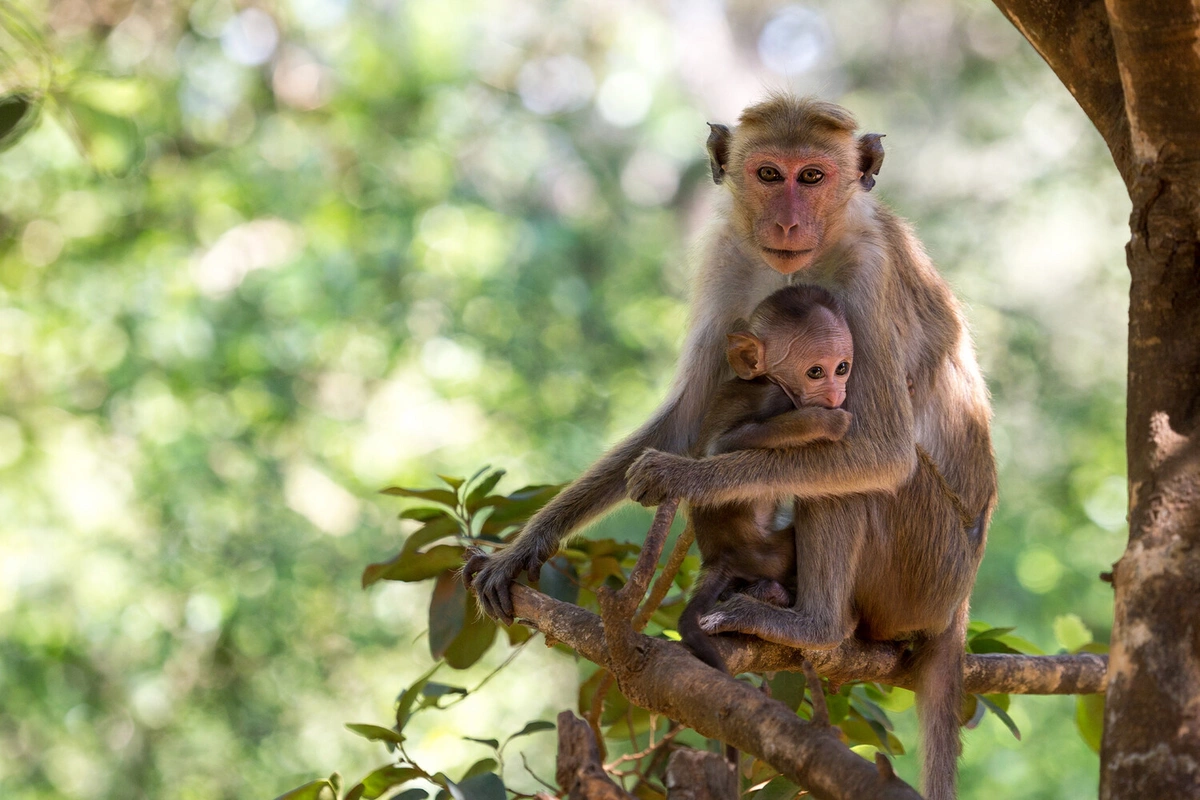
An experiment has shown that macaques, like humans, associate rounded shapes with the sound of the word "bouba" and angular shapes with the word "kiki." The results of the study were published on the bioRxiv portal.
The "bouba-kiki" effect was first described back in the 1920s: most people, regardless of language and alphabet, call an angular figure "kiki" and a rounded one "bouba." Now scientists have shown that macaques make a similar association. Nine monkeys from the Mandai Wildlife Reserve in Singapore participated in the experiment — eight long-tailed macaques and one pig-tailed macaque.
First, the animals were trained without any audio accompaniment to search for food under a lid with a hybrid, half-rounded and half-angular figure. In the main phase of the test, each monkey was offered a choice of two lids — one with a rounded and one with an angular figure — while a repeating recording of the word "bouba" or "kiki" was played. Each monkey underwent 24 trials in short blocks of three, and the placement of figures and sounds were alternated to eliminate systematic bias.
The results turned out to be similar to data from experiments with humans: macaques noticeably more often chose the lid with the rounded figure when "bouba" was played, and the angular one when "kiki" was played. According to statistical analysis, the odds of choosing the rounded figure when "bouba" was played were nearly six times higher than when "kiki" was played. The authors emphasize that studies with a larger number of animals are needed for more reliable conclusions. Nevertheless, the result is an early indication that the associations on which language is built may be rooted in something shared between humans and other primates.
"These findings shift the evolutionary question from whether the effect is unique to humans to how broadly such perceptual associations are distributed among vertebrates," the authors of the preprint noted.

Similar News

A tea that helps lose weight has been named
Ginger tea enhances thermogenesis, meaning it helps the body expend more energy even at rest, which promotes weight loss, gastroenterologist Evgeny Belousov fro...