

 Azərbaycanca
  По-русски
  English
 About us
Solar flares found to pose unexpected danger to people on Earth
Japanese physicists from Kyoto University have proposed a new theoretical model explaining the possible connection between disturbances in the ionosphere and the triggering of powerful earthquakes. According to the researchers, under certain conditions, electrical processes in the upper layers of the atmosphere can influence the stress state of the Earth's crust and increase the probability of seismic events.
As reported by BAKU.WS with reference to the International Journal of Plasma Environmental Science and Technology, the authors of the study suggest that in fractured sections of the crust, where water is present under high temperatures and pressures, structures may form that function as a kind of electrical capacitor. These zones, according to the Japanese specialists, create a large-scale electrostatic "earth–atmosphere" system, connecting the planet's surface with the lower ionosphere.
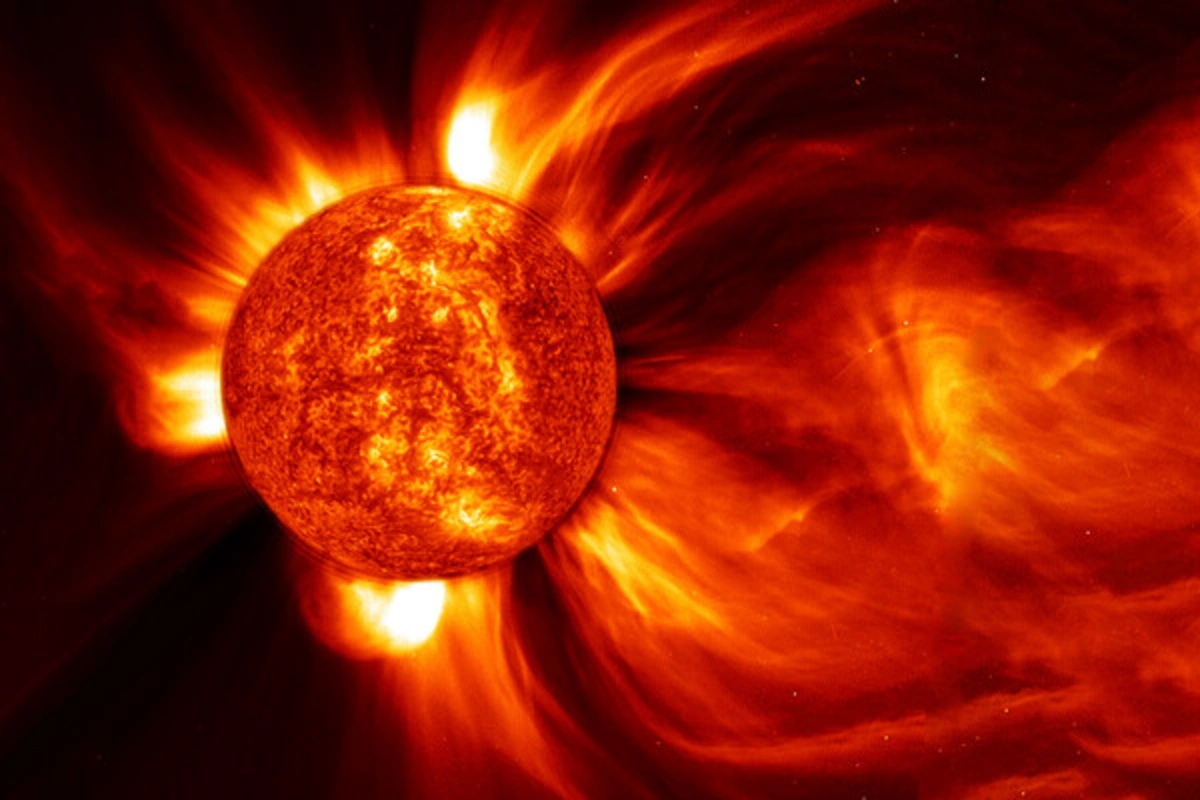
According to the scientists' calculations, during periods of powerful solar flares, the electron density in the ionosphere increases sharply, forming a negatively charged layer. Through a capacitive coupling mechanism, such a charge could theoretically induce strong electric fields in microcavities of rocks. The resulting electrostatic pressure can reach several megapascals — values comparable to tidal and gravitational stresses that are already considered by geophysicists as factors affecting fault stability.
According to foreign experts in the field of space weather, an increase in the total electron content of the ionosphere by tens of TEC units during major solar flares could potentially lead to additional pressure buildup in tectonic fault zones. This is not about a direct triggering mechanism, but rather a possible amplification of already existing stresses.
Interestingly, ionospheric anomalies have indeed been repeatedly recorded before strong earthquakes. Surges in electron density, changes in ionospheric altitude, and transformations in atmospheric wave propagation have been observed. Previously, such phenomena were more often interpreted as consequences of processes in the Earth's crust. The new concept allows for a two-way interaction: deep processes can affect the ionosphere, and its disturbances can exert a reverse effect on the crust.
The researchers also noted that some major earthquakes in Japan, including the event on the Noto Peninsula in 2024, occurred shortly after periods of increased solar activity. At the same time, the scientists emphasize that temporal coincidence does not prove a causal relationship.
Going forward, the team plans to combine satellite navigation data, which allows the creation of three-dimensional maps of the ionosphere, with space weather information. This will make it possible to more accurately assess whether atmospheric electromagnetic processes can actually influence the stress state of the Earth's crust.
Similar News

Horror on TikTok livestream: woman attacked interlocutor with a knife during broadcast
A shocking incident occurred on the social network TikTok, sending shockwaves through the online community. As reported by BAKU.WS, in Turkey, a TikTok user kno...