

 Azərbaycanca
  По-русски
  English
 About us
10 years have passed since the start of the April battles

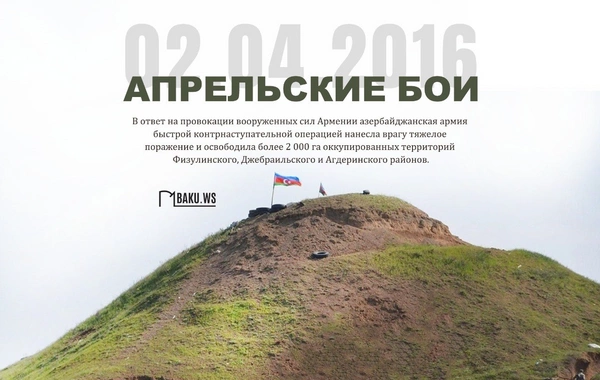
Ten years have passed since the beginning of the glorious April battles.
The Azerbaijani Army, in a lightning-fast counter-offensive operation conducted along the front line on April 2, 2016, in response to provocations by the Armenian armed forces that began in late March, inflicted a crushing defeat on the enemy. The Armenian side assumed it would teach Azerbaijan a lesson, but the opposite happened.
On the night of April 1-2, 2016, and throughout the day, all border positions and settlements of Azerbaijan were subjected to intense artillery shelling by the Armenian armed forces. As a result of the artillery shelling of Azerbaijani settlements located near the line of confrontation, six civilians were killed, including two children under the age of 16, and 26 people were seriously wounded.
As a result of the attacks, serious damage was also inflicted on numerous public and private property, including civilian infrastructure. A total of 232 private residential houses, 99 electric poles, three electrical substations, and kilometers of water and gas pipes were destroyed. The Armenian armed forces struck social facilities, including schools, hospitals, and places of worship, with guided missiles. One of the mosques was hit by large-caliber artillery shells during a worship service.
In order to suppress the Armenian provocation and ensure the safety of the civilian population, the command of the Azerbaijani Armed Forces decided to take urgent retaliatory measures in the Aghdara–Tartar–Aghdam and Khojavend–Fizuli directions.
As a result of the four-day military operation, sections of occupied territories in Fizuli, Jabrayil, and Aghdara districts with a total area of more than 2,000 hectares were liberated. Additionally, thousands of hectares of remaining territory came under the full control of the Azerbaijani Army.
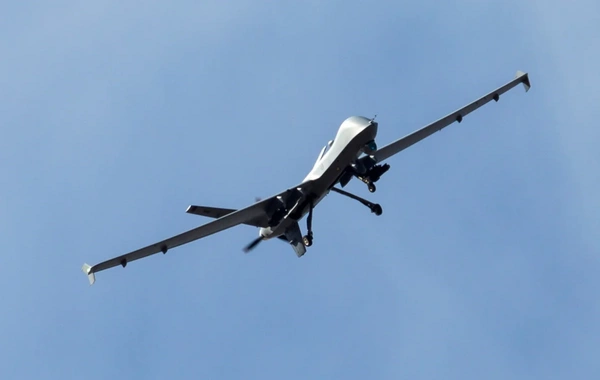
The mythical "Ohanyan defense line" was destroyed by our victorious army in just 20 minutes. In the April battles, Azerbaijan employed the most modern weapons, which greatly frightened Armenia, in particular, Harop kamikaze drones and TOS-1A heavy flamethrower systems, known as "weapons from hell."
The Azerbaijani Army liberated a number of important strategic heights, including Lele Tepe and Talish. The liberation of Lele Tepe, which allows control over a vast territory, ensured the safety of the settlement of Jojug Marjanli in Jabrayil district and the city of Horadiz in Fizuli district.
As a result of the crushing strikes by our army, over 30 tanks, 25 artillery systems, and other military equipment of the enemy were destroyed, and 320 Armenian servicemen were killed and more than a thousand were wounded. Control was established over a number of roads in the direction of the Goranboy village of Gulistan and the Tartar settlement of Sugovushan (then known as Madagiz).
Military operations were ceased on April 5 in accordance with the Moscow agreement between the chiefs of the general staffs of the Armed Forces of Azerbaijan and Armenia.
The four-day April battles marked the beginning of Azerbaijan's path to the Great Victory and played a decisive role in the liberation of the remaining territories from occupation.
On September 27, 2020, in response to yet another Armenian provocation, the Patriotic War began. Under the leadership of Supreme Commander-in-Chief Ilham Aliyev, the lands that had been under Armenian occupation for nearly 30 years were liberated. Over 44 days, five cities, four settlements, and 286 villages were liberated, including the city of Jabrayil and 90 villages of the district, the city of Fizuli and 53 villages of the district, the city of Zangilan, the settlements of Minjivan, Aghband, Bartaz and 52 villages of the district, the settlement of Hadrut and 35 villages of Khojavend district, three villages of Tartar district, the city of Gubadli and 41 villages of the district, nine villages of Khojaly district, the city of Shusha, three villages of Lachin district, several strategic heights in the direction of Aghdara and Murovdag, as well as the Bartaz, Sighirt, Shukurataz heights and five more unnamed heights in Zangilan.
The joyful news of the liberation of our lands from occupation was conveyed to the Azerbaijani people by the head of state, Supreme Commander-in-Chief Ilham Aliyev.
On November 10, a statement on the complete ceasefire and cessation of all military operations in the conflict zone was signed by the presidents of Azerbaijan and Russia and the prime minister of Armenia. This document became the embodiment of the capitulation of Armenia, which was unable to put up any resistance against the Azerbaijani Army on the battlefield.
In accordance with the trilateral statement, on November 20 the Aghdam district, on November 25 the Kalbajar district, and on December 1, 2020, the Lachin district were returned to Azerbaijan without a single shot being fired. Thus, the territorial integrity of Azerbaijan was restored, and the decades-long Karabakh conflict became a thing of the past.
In March 2022, Mount Farrukh and the settlement of the same name were liberated. On August 3, 2022, as a result of the retaliatory operation "Revenge" conducted by units of the Azerbaijani Army, the Girkhgiz, Saribaba heights and a number of other important strategic heights along the Karabakh range of the Lesser Caucasus were brought under control. Following this, Mount Buzduq and the adjacent heights came under the control of our army.
At the end of August of the same year, control was restored over the city of Lachin and the villages of Zabukh and Sus. During March 2023, military measures were taken on the Khankendi–
Similar News

Putin noted stabilization between Azerbaijan and Armenia
Armenia and Azerbaijan have managed to achieve stabilization of relations. As reported by TASS, this was stated by Russian President Vladimir Putin during talks...