


 Azərbaycanca
  По-русски
  English
 About us
Scientists discovered a lemon-shaped planet
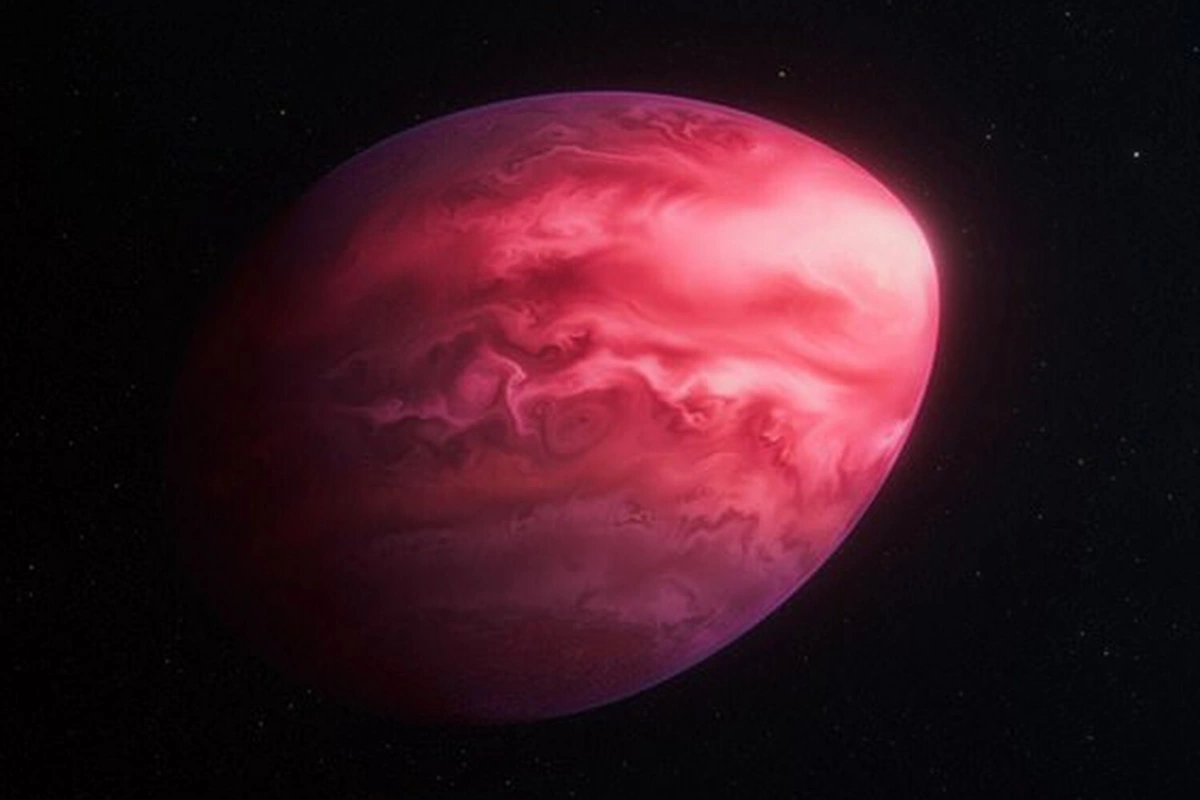
Scientists have reported the discovery of an extremely unusual exoplanet, the shape and composition of which do not fit into existing theories of planet formation, writes Daily Mail. The gas giant, designated PSR J2322-2650b, was discovered using the James Webb Space Telescope and has already generated widespread interest in the scientific community.
The planet is comparable in size to Jupiter, but its physical characteristics differ dramatically from anything astronomers have previously observed. Under the influence of extreme gravity, it has taken an elongated shape resembling a lemon. Scientists believe that the deformation is caused by the powerful gravitational influence of the star around which it orbits.
Unlike most known exoplanets, PSR J2322-2650b does not orbit an ordinary star, but a pulsar - a neutron star. The mass of such an object is comparable to that of the sun, but compressed to the size of a large city. The planet is located about 750 light-years from Earth and is just 1.6 million kilometers from its pulsar.
Due to such a close orbit, it is constantly exposed to powerful radiation, including gamma rays. One complete revolution around the star takes only about 7.8 hours.
Researchers were particularly surprised by the chemical composition of the planet's atmosphere. Telescope data showed the presence of molecular carbon with almost complete absence of water, methane, and carbon dioxide. According to Dr. Michael Zhang from the University of Chicago, this type of atmosphere has not previously been observed in any of the studied exoplanets.
PSR J2322-2650b is also the only known gas giant orbiting a neutron star. This makes it even more mysterious, as such stars typically either destroy neighboring objects with gravity or evaporate them with powerful radiation.
The origin of the planet remains unclear. According to researchers, it could not have formed either as a normal planet or as a result of a star's destruction. None of the known planet formation mechanisms explain such extreme carbon enrichment.
One working hypothesis suggests that during the cooling process inside the planet, carbon and oxygen could have crystallized, and then pure carbon crystals rose to the upper layers and mixed with helium. However, this theory does not explain the absence of nitrogen and oxygen in the atmosphere.
Similar News

The most dangerous habits that can lead to vision loss have been named
Even routine everyday actions can silently undermine your vision — from infections to serious injuries, experts warn. As reported by BAKU.WS with reference to "...