

 Azərbaycanca
  По-русски
  English
 About us
Today is the birthday of the author of the anthem of independent Azerbaijan, poet Ahmed Javad
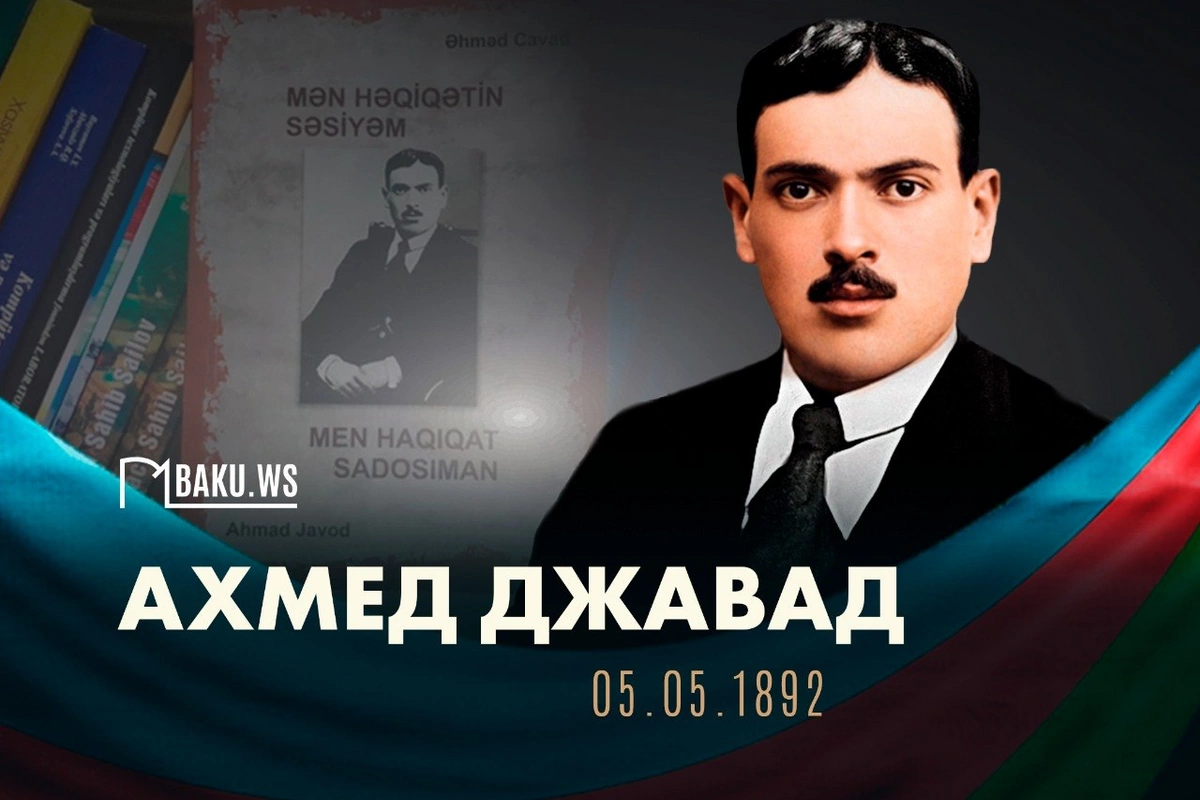
Today is the birthday of the poet, translator, author of the lyrics of the State Anthem of the Azerbaijan Democratic Republic and the independent Republic of Azerbaijan, member of the Union of Writers of Azerbaijan, Professor Ahmed Javad.
As BAKU.WS reminds, A. Javad was born on May 5, 1892, in the village of Seyfali in the Shamkir district. He received his primary education at home and knew Azerbaijani, Turkish, Persian, and Arabic languages as well as Eastern literature. After graduating from the theological seminary in Ganja in 1912, he worked as a teacher and participated in the literary and socio-political life of the city.
During the Balkan War, he fought on the side of Turkey as part of the "Caucasian Volunteer Detachment." As a member of the Mercy Society, he helped orphans and refugees in Kars, Erzurum, and other cities.
In 1916, Ahmed Javad's poetry collection "Goshma" was published, and in 1919 - "Dalga" ("The Wave"). This period of activity of Ahmed Javad, who gained fame as the poet of independence, was associated with Mammad Amin Rasulzade. At Rasulzade's suggestion, the poet joined the "Musavat" party.
The peak of the poet's creativity was associated with the ADR (Azerbaijan Democratic Republic), in the struggle for which the poet took an active part. In his poem "Azerbaijan, Azerbaijan!" Ahmed Javad welcomed the proclamation of the ADR. And he glorified the tricolor banner of Azerbaijan in the poem "To the Flag of Azerbaijan."
After the proclamation of the ADR, the poet continued his pedagogical activities, carried out cultural and educational work, assisting the ADR Minister of Education Yusifbeyli Nasib-bey. He took an active part in the establishment of Azerbaijan University. Ahmed Javad is the author of the anthem of the Republic of Azerbaijan, set to music by Uzeyir Hajibeyov. His poetry mainly captured the call for the unity of Turkic peoples.
After the establishment of Soviet power in Azerbaijan, Ahmed Javad continued his pedagogical activities. In 1920, he worked as a school principal and teacher of Russian and Azerbaijani languages in the village of Khulug in the Gusar district, and from 1920 to 1922 as the head of the Department of Public Education of the Guba district.
From 1922 to 1927, he studied at the Faculty of History and Philology of the Azerbaijan Pedagogical Institute, simultaneously working as a lecturer at the N. Narimanov Technical College.
From 1924 to 1926, he served as the executive secretary of the Society of Soviet Writers of Azerbaijan. In 1925, A. Javad was arrested for the poem "Goygol." In 1930, he moved to Ganja. From 1930 to 1933, he was a lecturer, then an associate professor and head of the Department of Russian and Azerbaijani Languages at the Institute of Agriculture in Ganja. In 1933, A. Javad was awarded the title of professor.
After that, he headed the literary department of the Ganja Drama Theater. In 1934, A. Javad returned to Baku and worked as an editor of the translation department at the "Azernashr" publishing house. From 1935 to 1936, he headed the documentary film department at the "Azerbaijanfilm" studio. In March 1937, A. Javad was awarded the first prize for translating Shota Rustaveli's poem "The Knight in the Panther's Skin" into Azerbaijani.
A. Javad translated into Azerbaijani the works of Russian writers and poets - A.S. Pushkin ("The Bronze Horseman"), M. Gorky ("Childhood"), and the prose of I. Turgenev. He also translated works of European classics - W. Shakespeare ("Othello"), F. Rabelais ("Gargantua and Pantagruel"), K. Hamsun ("Hunger").
In early July 1937, A. Javad was arrested. On October 13, 1937, he was executed by firing squad. Members of A. Javad's family were also subjected to repression. His wife Shukriya khanum was exiled to Kazakhstan, and their four children were separated.
In December 1955, A. Javad was exonerated. After that, his books "Sheirler" (1958), "Sen aglama, men aglaram" (1991) were published, as well as his translations: "Gargantua and Pantagruel" by F. Rabelais (1961), the tragedies "Othello" and "Romeo and Juliet" by W. Shakespeare (1962), and the poem "The Knight in the Panther's Skin" by Shota Rustaveli (1978).

Similar News

A screening of the documentary film "The Trace" was held at the Heydar Aliyev Center
On May 2, the Heydar Aliyev Center hosted the screening of the documentary film İz ("Trace") on the eve of the 103rd anniversary of the birth of the great leade...