


 Azərbaycanca
  По-русски
  English
 About us
The secret power of dark matter exceeded scientists' expectations

Physicists from the Perimeter Institute for Theoretical Physics studied a hypothetical "dark force" — an additional interaction between dark matter particles beyond gravity — and discovered that its effect is the opposite of what was expected. The results were published in the Journal of Cosmology and Astroparticle Physics (JCAP).
The idea of such a force arose from discrepancies between different cosmological measurements, particularly data from the DESI survey on dark energy and results on cosmic microwave background clustering. The scientists, led by Zachary Weiner, modeled how an additional attraction between dark matter particles would affect the formation of structures in the Universe.
It turned out that although such a force does indeed cause dark matter to cluster more effectively, it also leads to dark matter particles effectively "losing mass" as the Universe expands — weakening their gravitational influence. As a result, the overall effect most often suppresses the growth of large-scale structures rather than accelerating it, as was initially assumed.
According to the researchers, the finding is important for dark energy models related to DESI data: any theory proposing hidden self-interaction of dark matter must account for this effect of the "effective lightening" of particles as the Universe expands.

Similar News
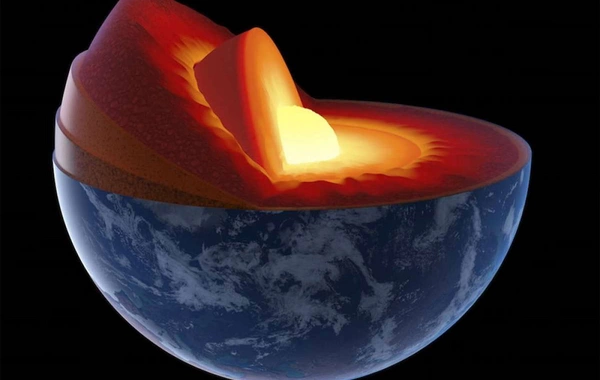
An unexpected discovery has been found in the Earth's core
American researchers modeled the state of hydrogen in Earth's inner core and concluded that so-called superionic hydrogen may exist there — a substance that flo...