

 Azərbaycanca
  По-русски
  English
 About us
Scientists of ANAS spoke out against the campaign surrounding the Gandzasar Monastery
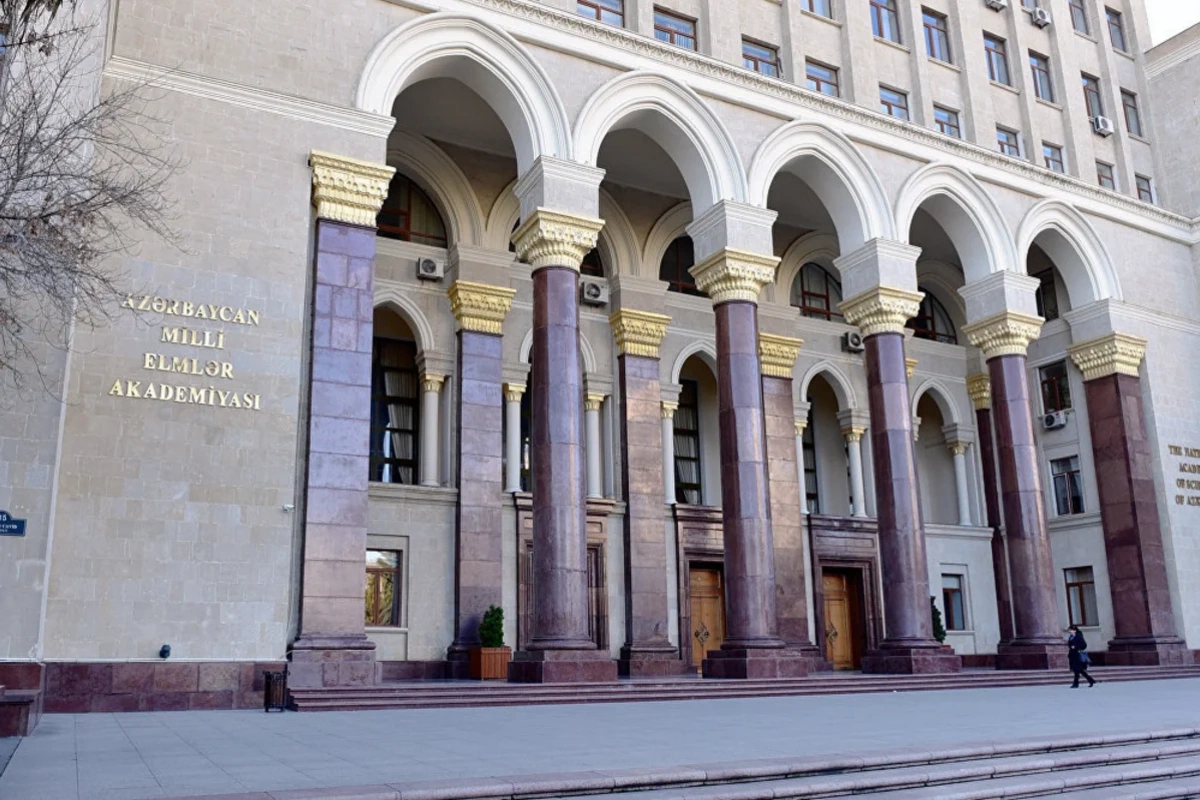
In recent days, a targeted campaign has unfolded in Armenia around the monuments of Caucasian Albania located in the territory of Karabakh, particularly the Gandzasar Monastery, which, in our opinion, has no connection to historical and scientific realities.
This is stated in the declaration of the staff of the National Academy of Sciences of Azerbaijan regarding the scandal created in Armenia around the Gandzasar Monastery.
The text of the declaration states:
"The Gandzasar Monastery, which is an important part of the eponymous monastic complex, is a historical monument belonging to the heritage of Caucasian Albania. The attribution of this monument to Albania and its indigenous population — the Albanians — is, according to Azerbaijani researchers, confirmed by historical and archaeological data.
One of the arguments is the location of the monastery on the historical-geographical territory of Caucasian Albania. This territory was one of the main provinces of the state of Caucasian Albania and underwent its historical development as part of it. After the fall of the Arab Caliphate, the authority of the Albanian Kingdom was partially restored here.
In the 12th–13th centuries, the Albanian-Khachen Principality rose to prominence in this territory. Its ruler was Hasan Jalal (1215–1261). According to the position of Azerbaijani scholars, Hasan Jalal and his wife descended from the Albanian Mehranid dynasty. In sources of that period, he is mentioned under such titles as "prince of princes," "prince of the land of Khachen," "king of Albania," and others.
During the reign of Hasan Jalal, these lands experienced an economic, political, and cultural rise, which in Azerbaijani historiography is characterized as the Albanian Renaissance. The Gandzasar Monastery, as stated in the declaration, was erected as one of the significant monuments of this era.
An equal-armed cross was used in the monastery, which the authors of the declaration associate with the Albanian tradition. It is also noted that the structure was built from local building materials of the region.
Furthermore, the declaration states that epigraphic inscriptions on a number of monuments in Karabakh, including Gandzasar, are regarded by Azerbaijani researchers as texts belonging to the Albanian heritage. These inscriptions are described as a unique stone chronicle of the monastery.
The authors of the declaration also reference a book dedicated to the epigraphic texts of Gandzasar, published in 1919 in Petrograd, claiming that it contains information confirming the monument's attribution to Albanian heritage. The frescoes of the monastery are cited as another argument.
In the opinion of the signatories, during the Soviet period and subsequently during the occupation, targeted actions were undertaken to alter the original appearance of the monastery. The declaration asserts that some epigraphic monuments were destroyed, dismantled, or removed, and some inscriptions were replaced. Interference with the form of the crosses, the burials of Albanian catholicoi, and the original structure of individual elements of the complex is also mentioned.
Additionally, the authors of the declaration claim that during the occupation, construction materials brought from Armenia were used under the guise of restoration work, which, in their opinion, damaged the original appearance of the monument.
Against this backdrop, the reaction that emerged in Armenia following the visit of representatives of the diplomatic corps accredited in Azerbaijan to the liberated territories is viewed by the signatories as an attempt to challenge the interpretation of the monument's history presented by the Azerbaijani side.
We believe that the campaign unfolding around the Gandzasar Monastery lacks sufficient scientific and historical basis and is capable of damaging the peace agenda between Azerbaijan and Armenia.
In the opinion of the signatories, such approaches are a continuation of a longstanding policy of appropriating elements of Azerbaijan's historical and cultural heritage and hinder objective scholarly dialogue.
Azerbaijani scholars firmly condemn the campaign launched in Armenia around the Gandzasar Monastery and call on the Armenian side to proceed not from politicized propaganda, but from the objective scholarly study of historical sources and monuments."
The declaration was signed by:
Isa Habibbayli — President of ANAS, Academician
Govhar Bakhshaliyeva — Vice-President of ANAS, Academician
Ismail Hajiyev — Chairman of the Nakhchivan Division of ANAS, Academician
Teymur Karimli — Director of the Muhammad Fuzuli Institute of Manuscripts of ANAS, Academician
Nargiz Akhundova — Academician
Artegin Salamzade — Director of the Institute of Architecture and Art of ANAS, Corresponding Member of ANAS
Hajifahreddin Safarli — Corresponding Member of ANAS
Konul Bunyadzade — Corresponding Member of ANAS
Veli Bakhshaliyev — Corresponding Member of ANAS
Jafar Giyasi — Corresponding Member of ANAS
Karim Shukurov — Director of the Abbasgulu Agha Bakikhanov Institute of History and Ethnology of ANAS, Doctor of Historical Sciences, Professor
Ilham Mamedzade — Director of the Institute of Philosophy and Sociology of ANAS, Doctor of Philosophical Sciences, Professor
Farhad Guliyev — Director of the Institute of Archaeology and Anthropology of ANAS, PhD in History, Associate Professor
Kubra Aliyeva — Doctor of Art Studies, Professor
Gafar Jabiyev — Doctor of Historical Sciences, Professor
Aliaga Mamadli — Doctor of Anthropological Sciences, Professor
Allahverdi Ali

Similar News

Leyla Aliyeva recited a poem by Nusret Kesemenli
Vice President of the Heydar Aliyev Foundation, founder and leader of the IDEA Public Association Leyla Aliyeva recited the poem Mənə bir az ondan danış by Azer...