

 Azərbaycanca
  По-русски
  English
 About us
Azerbaijan Consolidates Its Status as a Key Hub of Eurasia: Following Ilham Aliyev's Interview at WUF13
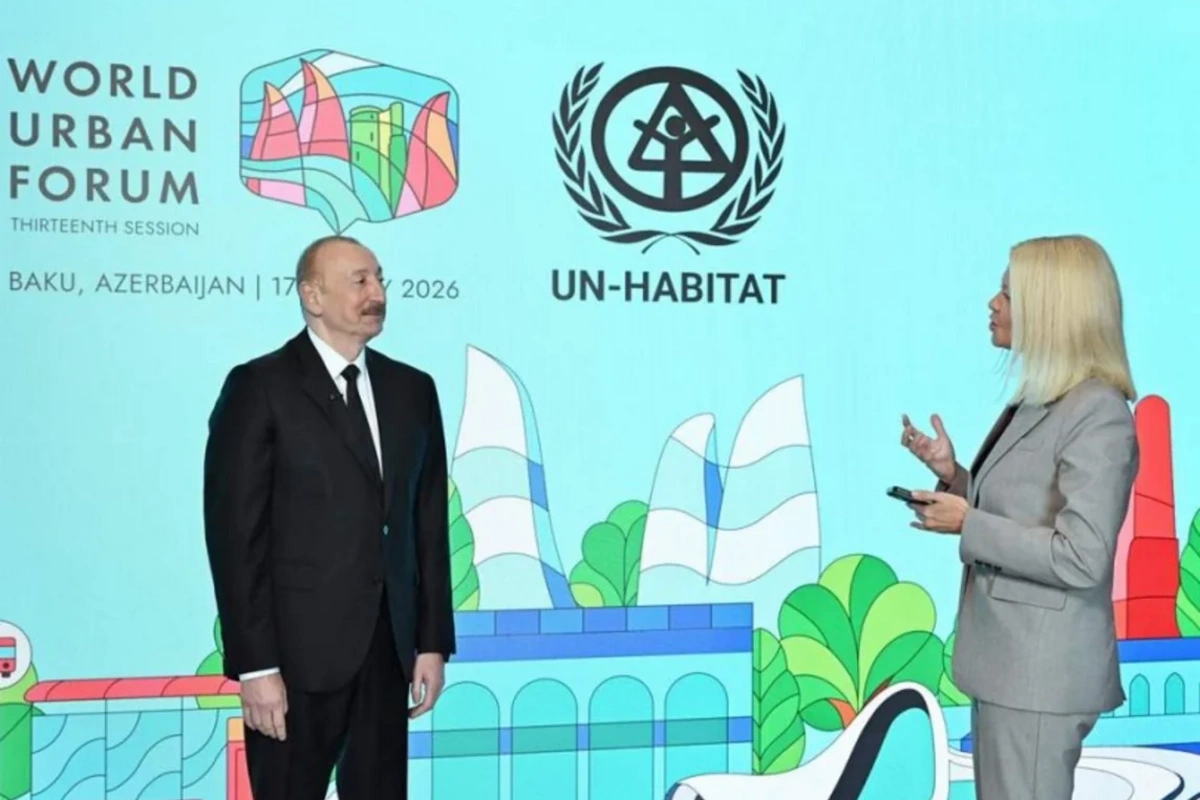
One of the landmark events of the 13th session of the World Urban Forum (WUF13) was President Ilham Aliyev's interview with Euronews, writes the newspaper "Kaspi."
In the interview, the head of state outlined the key directions of Azerbaijan's current policy, oriented toward transforming the country into one of the most important communication hubs of Eurasia and the broader international space. The hosting of WUF13, as well as COP29 in 2024, demonstrates that such a model is already gradually being implemented in practice. Baku strives to become not only an energy and transport center of the region but also an international platform for global discussions in the political, infrastructural, climate, and other spheres.
The President particularly emphasized that representatives of 182 countries gathered in Baku, a record number for such an event, testifying to the respect for Azerbaijan. In another context, speaking about the implementation of our country's energy policy, Ilham Aliyev specifically noted that without diplomacy, ensuring the access of Azerbaijani energy resources to foreign markets would have been impossible. According to him, the implementation of major energy and infrastructure projects required building sustainable relations with neighboring states, as well as with a broader circle of regional partners through whose territories export and transit routes pass. In essence, this was about forming a multilateral cooperation system within which the interests of producers, transit states, and consumers should be interconnected and mutually beneficial.

At the same time, the President of Azerbaijan emphasized that the current escalation in the Middle East and rising oil prices do not bring unequivocal benefits even to oil-producing states. Against the backdrop of global economic instability and falling stock markets, energy-exporting countries also incur losses on their foreign investments and financial assets.
In this sense, Baku does not view energy policy in isolation from global macroeconomic processes, proceeding from the premise that large-scale geopolitical instability, crises of transport arteries, and turbulence in the global economy ultimately have a negative impact on both consumers and energy exporters themselves.
In the mirror of recovery
As for the process of restoration of the Karabakh and East Zangezur regions of Azerbaijan itself, to a certain extent it can already be regarded as a kind of model of comprehensive post-conflict territorial reconstruction, combining infrastructure restoration, technological modernization, environmental transformation, and the creation of new spatial management models. Baku seeks to demonstrate that this is not merely about restoring destroyed settlements, but about building from scratch a modern urban environment based on the concepts of "smart city," "smart village," digital governance, green energy, and modern transport infrastructure. Simultaneously, this process is being used by Azerbaijan as a tool for the country's international positioning as a state capable of implementing large-scale infrastructure and technological projects in post-conflict conditions.
In this context, cooperation with UN structures, particularly the UN-Habitat programme, acquires special significance. For international organizations, such experience is of practical interest against the backdrop of the persistently large number of regions in the world affected by devastating armed conflicts and in need of comprehensive reconstruction and restoration of a normal socio-economic environment. According to international bodies, the number of internally displaced persons due to conflicts and violence worldwide in recent years exceeds 70-80 million people, and large-scale crises continue to persist in Sudan, Ukraine, the Gaza Strip, Syria, Afghanistan, Myanmar, the Democratic Republic of the Congo, Yemen, Lebanon, Haiti, and a number of other states.
In effect, we are talking about dozens of major territories and urban areas where transport, energy, utility, and social infrastructure has been destroyed, and the international community faces the task of long-term post-conflict renovation.
Through the prism of development
Azerbaijan, through its own example, demonstrates a potential model of post-conflict development combining modern technologies, environmental standards, digitalization, and infrastructure integration. In the long term, the accumulated experience of restoring the Karabakh and East Zangezur regions may be used by international structures as one of the practical examples in developing future UN programs for the restoration of territories destroyed as a result of wars and prolonged conflicts.
A special place in Azerbaijan's external positioning is given to its role in the development of new Eurasian logistics. This primarily concerns the development of the Middle Corridor, modernization of the railway network, expansion of the capacity of the Baku International Sea Trade Port, construction of new highways, as well as the country's integration into the emerging Eurasian logistics chains between China, Central Asia, the South Caucasus, Turkey, and Europe. Thus, Baku is effectively promoting the thesis of Azerbaijan's transformation into one of the key transit hubs of Eurasia against the backdrop of geopolitical transformation of traditional routes following the Ukrainian crisis, problems in the Red Sea, and growing instability around the Strait of Hormuz.
In practice, Azerbaijan is seeking to secure the status of a state playing the role of not only a transport and energy hub but also an international platform for political, infrastructural, and institutional interaction. In this context, the hosting of WUF13 in Baku became yet another confirmation of the country's aspiration to strengthen its role as one of the centers of global dialogue and international cooperation.