Azərbaycanca
 По-русски
 English

 About us
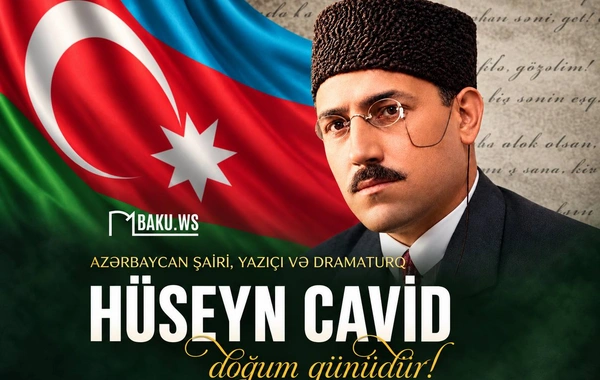
Today is the birthday of Huseyn Javid

Today marks the birthday of one of the most prominent representatives of romanticism in Azerbaijani literature, the great poet and playwright Huseyn Javid.
Huseyn Javid (birth name Huseyn Abdulla oglu Rasizade) was born on October 24, 1882, in the city of Nakhchivan, where his family had moved from the village of Shakhtakhty. His father was a clergyman. He received his primary education at a religious school (mollakhana) and then enrolled in Muhammad Taqi Sidqi's school "Mektebi-Terbiye" in his hometown. From 1899 to 1903, he continued his education at the "Talibiyya" madrasa in Tabriz (Southern Azerbaijan). He graduated from the literary faculty of Istanbul University and taught in Nakhchivan, Ganja, and Tbilisi, and from 1915 onward — in Baku.
Huseyn Javid is one of the masters who developed the best traditions of classical Azerbaijani literature. He was one of the founders of 20th-century Azerbaijani progressive romanticism.
Javid's work is distinguished by a diversity of genres and forms. He is the author of lyrical poems, lyrico-epic and epic poems, and the first verse tragedies and dramas in Azerbaijani literature. His first collection of poems titled "Keçmiş günlər" ("Days Gone By") was published in 1913.
Huseyn Javid is better known as a playwright. His philosophical and historical tragedies, family and domestic dramas, from the standpoint of innovation in style and manner of writing, represented a new stage in Azerbaijani dramaturgy, characterized as the "Theater of Javid," which exerted a strong influence on the development of national theatrical culture. His dramaturgy reflected universal human problems of the time that held great socio-political and cultural significance.
In the work "Sheikh Sanan" (1914), the first verse tragedy in Azerbaijani literature, he expressed the idea of a universal religion for uniting peoples. During this period, Huseyn Javid gradually came to the idea that "rights are not given, they are won."
In the tragedy "Iblis" (1918), which holds a special place in his work, all the reactionary forces of the time — proponents of the "man is a wolf to man" philosophy, circles of "cultured savages of the 20th century" — were generalized in the image of the Devil, and wars of conquest were condemned.
In 1926, Huseyn Javid traveled to Germany for medical treatment. After living seven months in Berlin, he returned with a number of political-lyrical and lyrico-epic poems reflecting the spiritual turmoil of the intelligentsia.
In the 1920s and 1930s, Javid wrote a number of historical dramas. The historical dramas "Sayavush" (1933) and "Khayyam" (1935), written after "The Prophet" (1922) and "Timur the Lame" (1925), marked a turning point in his views on history and historical figures.
During the dark period of totalitarianism in the Soviet Union, Huseyn Javid considered it unacceptable to write about the "achievements" of socialism and firmly refused to glorify Stalin and the rulers of Azerbaijan. For this very reason, this courageous man was exiled to Magadan and died on December 5, 1941, in the Zaplag (Western Corrective Labor Camp), the village of Shevchenko in the Taishet district of Irkutsk Oblast.
In 1981, a house-museum of the great playwright was established in Nakhchivan.
It should be noted that the 100th anniversary of Huseyn Javid was widely celebrated in our country.
On the eve of the jubilee, on the initiative of national leader Heydar Aliyev, the writer's remains were transported from Irkutsk Oblast to Nakhchivan and buried near his house-museum. A magnificent mausoleum was erected over Huseyn Javid's grave. One of the avenues in Baku's Yasamal district is named after him.


Similar News
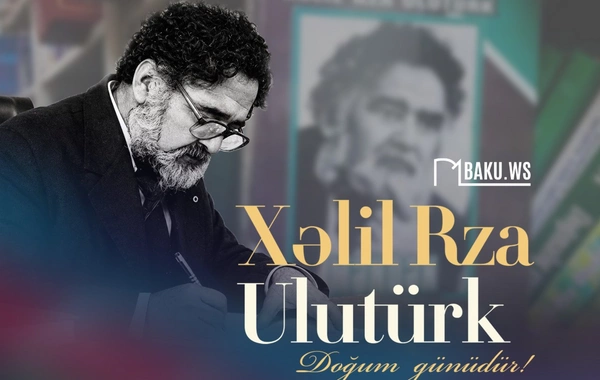
Today is the birthday of the people's poet Khalil Rza Ulutürk
Today marks the 94th anniversary of the birth of the prominent representative of Azerbaijani literature, philosopher and thinker, poet Khalil Rza Ulutürk. He wa...