

 Azərbaycanca
  По-русски
  English
 About us
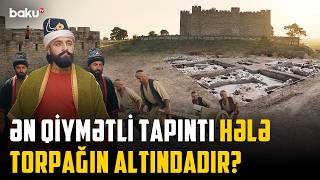
The Mystery of Shahbulag: What Does the Ancient Settlement in the Aghdam District Hide?

A new episode of the program "See What We Have Returned" (Gör nələri qaytarmışıq) on Baku TV is dedicated to the 18th-century Shahbulag fortress in the Aghdam district.
The structure is one of the most important architectural examples that have survived to our days from the time of the Karabakh Khanate. After the Bayat fortress, Panahali Khan chose Shahbulag, which was distinguished by its abundance of water, steep cliffs, and natural defense capabilities. Here he formed not just a fortress, but a small town consisting of a mosque, a bathhouse, a market, and a residential complex.
However, the history of Shahbulag does not begin in 1751-1752. The era of Panahali Khan became merely a new page in the centuries-old history of this place.
The head of the "Shahbulag" archaeological expedition, Tavakkul Aliyev, noted that during the occupation, this territory was subjected to illegal excavations by Armenians aimed at falsifying historical facts. Since 2024, the expedition has been conducting research here. Each new finding shows that life existed here continuously starting from the 2nd century BC.
It was emphasized that the history of this place developed sequentially, without erasing the traces of previous eras. The mystery of Shahbulag is not limited to the 18th-century fortress walls alone — it is an ancient settlement that has absorbed millennia of history, layer by layer.
An interesting question is whether the famous city of Aguen, where Albanian King Vachagan III the Pious held a great church council, was located on the territory of Shahbulag? Do the remains of a large church near the fortress prove this historical theory?

Similar News
In the Union of Composers of Azerbaijan, there was a call to develop and popularize academic music
Chairperson of the Union of Composers of Azerbaijan Firangiz Alizade called for special attention to the development, preservation, and promotion of academic mu...